A Statement on Images Without Events
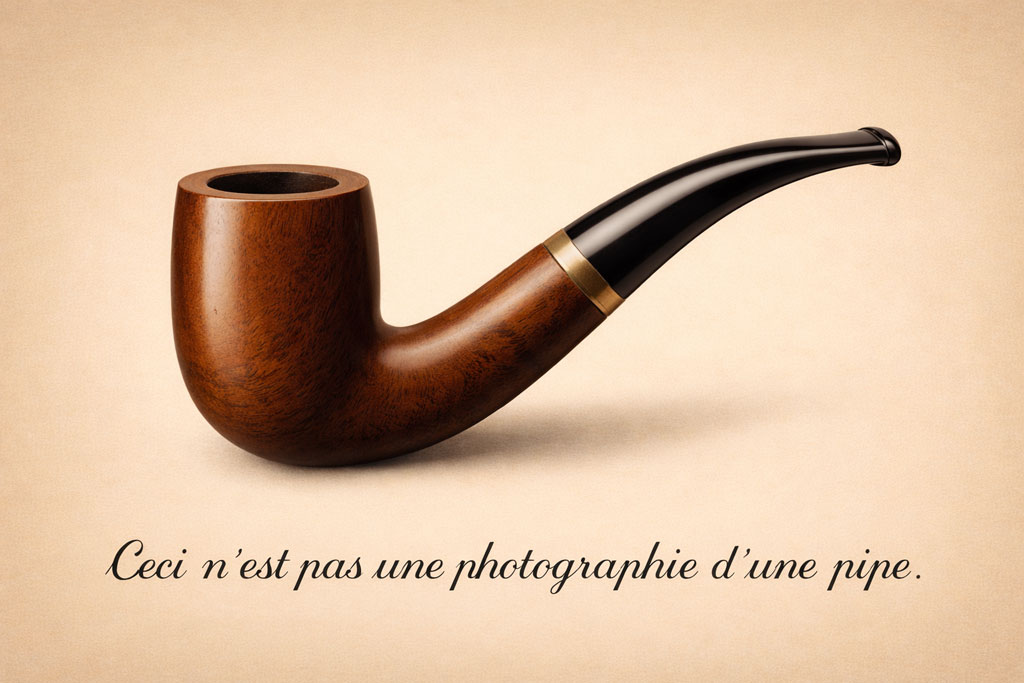
This is not a photograph.
It looks like one. It behaves like one.
It carries the same authority, the same quiet threat of truth.
But nothing stood in front of a lens. Nothing happened.
A photograph once implied an event:
light touched a surface, a moment was interrupted, time left a scar.
Even when manipulated, staged, or framed to deceive,
there was still a witness—mechanical, imperfect, complicit.
That witness is gone.
What remains is resemblance without origin.
Like Magritte’s pipe, this image insists on what it is not.
You cannot step into it. You cannot return to the moment it suggests.
There was no before. There will be no after.
Only a statistically plausible memory, assembled from the dead weight of other images.
AI does not capture the world.
It predicts it.
It does not remember—it averages.
It does not observe—it synthesizes.
It does not lie so much as it replaces the need for truth.
These images feel real because they are trained on reality’s residue.
They inherit the grammar of photographs without inheriting their obligations.
They borrow the emotional shorthand of evidence while refusing accountability.
This is not documentation.
This is not testimony.
This is not proof.
And yet we recognize it.
That recognition is the danger.
We are entering an era where the image no longer points outward—to an event, a body, a place—but inward, to a closed system of reference. A hall of mirrors that insists it reflects the world while quietly severing the connection.
The crisis is not that images can be fake.
Images have always lied.
The crisis is that images no longer need a world to misrepresent.
This work does not ask you to reject the image.
It asks you to hesitate.
To sit inside the discomfort of belief without evidence.
To feel the authority drain from the surface while the surface remains convincing.
To remember that realism is a style—not a guarantee.
This is not a photograph.
It is a warning label applied too late.
