There is a persistent fantasy in modern life that collapse will announce itself loudly.
People imagine alarms. Sirens. A single terrible day when the market drops to zero, the lights go out, and the news anchors remove their jackets and confess that the game is over. In the popular imagination, decline arrives like a thunderclap—sudden, undeniable, cinematic.
History suggests something else entirely.
Empires do not fall in a day. They loosen. They fray. They unwind.
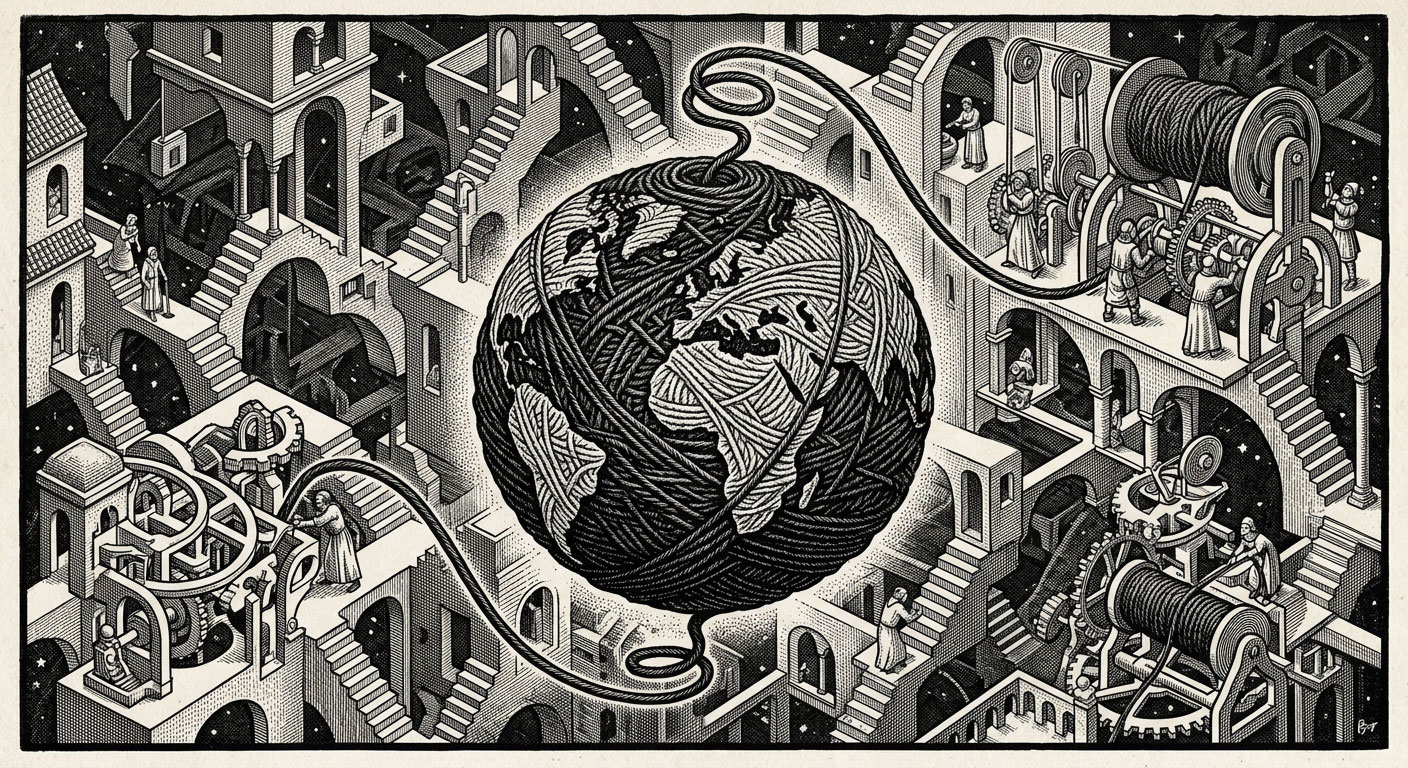
The rope does not snap. It slowly unravels, one fiber at a time, until the day comes when you reach for it and discover that it was no longer a rope at all—just a handful of threads pretending to hold weight.
The peculiar danger of this process is that no single moment feels decisive. Each small degradation is tolerable. Each compromise appears temporary. Each indignity can be explained away as an exception to the rule rather than evidence that the rule itself has quietly expired.
A generation ago, certain things would have been unthinkable. Not illegal, necessarily—just beyond the bounds of what a functioning society would tolerate. But the imagination has remarkable elasticity. It stretches. And stretches again. What once provoked outrage soon becomes controversy. Controversy becomes debate. Debate becomes background noise. Eventually it becomes Tuesday.
This is the genius of the unwinding. It operates below the threshold of alarm.
The markets still open each morning. The supermarkets remain stocked. The planes depart on time. Streaming services release new shows. Elections are held. Speeches are given. Reports are written. Panels convene to discuss the panels that came before them. The machinery of normal life continues humming loudly enough to drown out the quieter sound of things coming apart.
Meanwhile, the underlying assumptions—the invisible architecture that once held everything upright—begin to soften.
Institutions lose credibility but keep their letterhead.
Laws remain on the books but are applied selectively.
Truth becomes negotiable.
Competence becomes optional.
Serious matters are reduced to spectacle, and spectacle becomes indistinguishable from governance.
At first this is shocking.
Then it becomes exhausting.
Eventually it becomes ordinary.
Human beings are remarkably adaptable creatures. This is often described as a strength. It allows us to survive disasters and rebuild civilizations. But it also allows us to normalize decay with astonishing speed.
We adapt downward just as easily as upward.
The historian, looking backward, sees the pattern clearly. There are charts. Footnotes. Timelines. One can identify the moment when the fiscal foundation became untenable, when the political system hardened into paralysis, when cultural norms began dissolving faster than they could be replaced.
But the people living through it rarely recognize the pattern in real time.
They tell themselves a familiar story: It will be different this time.
The debt is manageable.
The institutions are resilient.
The guardrails will hold.
Someone, somewhere, must surely be in charge.
Besides, the market rallied this afternoon.
And so the unwinding continues, unnoticed not because it is invisible, but because it is incremental. Each turn of the screw is small enough to ignore. Each day resembles the one before it closely enough to maintain the illusion that the trajectory is stable.
Until, one day, the accumulated compromises begin to show.
The bridge stands exactly as it did yesterday—until the moment it doesn’t.
By then the historians will begin assembling their explanations. The warning signs will seem obvious in retrospect. Entire books will be written about the years when the outcome could still have been avoided.
People will read them with great interest.
And somewhere, in another time and another place, a new society will be telling itself the same comforting story—that decline always happens to someone else, somewhere else, long ago.
That it will be different this time.
It never is.
The purpose of saying this aloud is not optimism. Warnings rarely alter the course of large systems. The momentum of an age is a difficult thing to redirect, particularly when so many benefit—at least temporarily—from pretending nothing is wrong.
But occasionally, a few people notice the loose threads.
They pull gently and feel the tension that is no longer there.
They look around at the elaborate structures still standing and wonder how much of it is real and how much is simply habit—customs continuing long after the reasons for them have disappeared.
These people are sometimes dismissed as pessimists.
More often they are ignored entirely.
Which is perhaps the final stage of the unwinding: when the evidence is no longer hidden, yet the will to confront it has quietly evaporated.
By then the rope has already come apart in your hands.
The only remaining question is how long the illusion of strength can continue before gravity reintroduces itself.
And gravity, unlike markets or elections or public opinion, has never once decided that this time will be different.
